Mobility
of Solid Hydrogen Films 
Experimental Methods
Mobility
of Solid Hydrogen Films
Experimental Methods
We have studied surface mobility in equilibrium
films of H2 and D2 using a hole burning technique
which gives a direct measurement of mass transport in thin solid hydrogen
films. A hole is created in the film by desorbing hydrogen molecules with
a heat pulse applied to a heater on the substrate beneath the film (refer
to Fig. 1a). 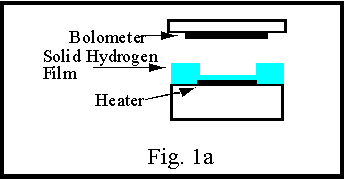 The
desorbed molecules are detected by a superconducting transition edge bolometer.
After a delay time which can range from fractions of a second to hundreds
of hours, a subsequent pulse desorbs the hydrogen which has been transported
back onto the heater. The resulting bolometer signal is proportional to
the number of molecules which have accumulated on the heater during the
delay. These measurements determine the rate of mass transport in the hydrogen
film as a function of time; repeating these measurements at different temperatures
yields the activation energy for surface transport.
The
desorbed molecules are detected by a superconducting transition edge bolometer.
After a delay time which can range from fractions of a second to hundreds
of hours, a subsequent pulse desorbs the hydrogen which has been transported
back onto the heater. The resulting bolometer signal is proportional to
the number of molecules which have accumulated on the heater during the
delay. These measurements determine the rate of mass transport in the hydrogen
film as a function of time; repeating these measurements at different temperatures
yields the activation energy for surface transport.
Our experiments were performed inside a double walled isothermal cell suspended in vacuum and thermally coupled to a continuously filling 4He refrigerator. The cell could be thermally regulated between 1.6 K and 30 K. A heated fill line connected the cell to a room temperature source of pure hydrogen gas. Normal H2 (75% ortho,25% para) and normal D2 (66% para,33% ortho) were used for the experiments. The heated fill line was used to introduce the gas into the cell at saturated vapor pressure conditions. The gas was introduced with the temperature of the cell slightly above the triple point of hydrogen (deuterium), after which the cell was slowly cooled back down to the desired temperature. During the experiments, the cell was isolated from the fill line by a low temperature valve.
Although enough gas is introduced into the cell to form several cubic millimeters of solid, most of the surface area is coated with a film only a few monolayers thick while the remainder of the material forms a bulk crystallite at a favorable nucleation site on the bottom of the cell. The equilibrium thickness of the film is determined by the condition that the free energy is minimized at that value [9]. The substrate is said to be wet if the minimum occurs at infinite thickness. Solid hydrogen is known not to wet most substrates [10], which means that it has a finite thickness at equilibrium. We determined the equilibrium thickness in our apparatus using a quartz microbalance which was mounted at the same height (3 cm) above the bottom of the cell as the heater film and bolometer. The equilibrium thickness on the gold surfaces of the microbalance was approximately 4 layers, and we assume that a similar film existed in equilibrium on the heater surface.
The heater consists of a thin Nichrome film (1 mm by 0.3 mm) evaporated onto a sapphire substrate (1.5x1x1 cm). The heater resistance is 1.5 kW (for H2) and 150 W (for D2). A pulse generator was used to provide 20 V rectangular pulses of duration 1 ms and 0.1 ms for H2 and D2 respectively. The power density going into the heater indicates that the temperature of the heater is locally raised to ~ 8.8 K for H2 and ~15.6 K for D2 [11]. The resistances of the heater and the duration of the pulses were chosen so that these heat pulses would not desorb the most strongly bound layers of the solid hydrogen (deuterium) film above the heater. At a fixed temperature, the desorption rate is a strong function of the binding energy, which in turn is a strong function of the hydrogen coverage. The binding energy of the first two layers of H2 are approximately 340 K and 170 K, respectively, for a wide variety of substrate materials [12], while the binding energy of subsequent layers rapidly approaches the bulk latent heat of 95K. For our experimental conditions, kinetic theory [13] shows that the heat pulse completely desorbs the third and higher layers and leaves the first two layers intact. This ensures that the bolometer detects only the reaccumulated film with every pulse of the heater. Since mass transport always takes place on top of the two strongly bound layers of hydrogen, we expect that our results are independent of the details of the composition of the heater or substrate.
The bolometer is evaporated on a separate sapphire substrate and placed a short distance (~1 mm) above the heater (see inset Fig. 1a). The bolometer is biased at its sharp superconducting transition point at each temperature by means of a magnetic field. The bolometer signal as a function of time due to molecules desorbed from the heater is shown in Fig. 1b. The shape of the signal reflects the thermal distribution of molecular velocities, which is determined by the isotopic mass and the heater temperature. The area under the curve is proportional to the number of hydrogen(deuterium) molecules desorbed and therefore to the amount of film that reaccumulated in the hole since the previous pulse. The integral of the bolometer signal, which we denote as the signal amplitude, is a useful measure of the amount of adsorbate on the heater.
Unless special precautions were taken, the low
temperature bolometer signal for H2 did not look like that shown
in Fig. 1b,
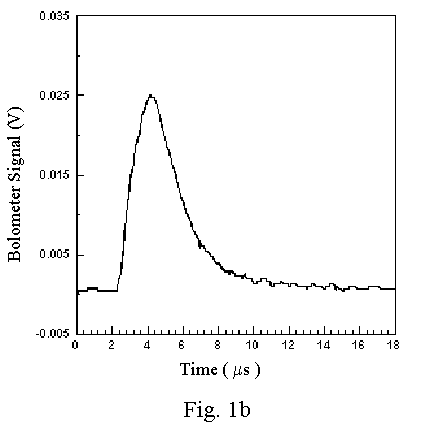 but rather had two peaks with distinct arrival times. The smaller peak which
arrived later was particularly visible for short delay times when the signal
due to hydrogen was still small. The ratio of the arrival times of the
two peaks was approximately
but rather had two peaks with distinct arrival times. The smaller peak which
arrived later was particularly visible for short delay times when the signal
due to hydrogen was still small. The ratio of the arrival times of the
two peaks was approximately .
The
.
The  dependence
of the thermal velocity indicates that the slow signal is due to an impurity
of mass 4. The fact that this component of the signal had a very rapid
relaxation time even at our lowest temperatures strongly suggests that
the surfaces were contaminated with helium. We verified that the source
of the helium was not a leak to the bath, but rather came directly from
the research grade gas bottle supplied by the manufacturer with a specified
purity of six nines. The residual pressure of helium in the low temperature
cell could be estimated from the characteristic recovery time for the mass
4 signal. Our estimates of the helium pressure are compatible with the
stated gas purity, but the bolometer signal is extremely sensitive to helium
contamination since it is concentrated in the gas and forms an adsorbed
film on top of the hydrogen. The amount of helium in the cell could be
reduced by several orders of magnitude by vacuum distillation at T ~9 K.
Variation of the helium concentration over this range did not significantly
affect the relaxation times of the hydrogen film. Our experience with nominally
high purity hydrogen suggests that previous experiments on hydrogen surfaces
may also have been covered with thin films of helium.
dependence
of the thermal velocity indicates that the slow signal is due to an impurity
of mass 4. The fact that this component of the signal had a very rapid
relaxation time even at our lowest temperatures strongly suggests that
the surfaces were contaminated with helium. We verified that the source
of the helium was not a leak to the bath, but rather came directly from
the research grade gas bottle supplied by the manufacturer with a specified
purity of six nines. The residual pressure of helium in the low temperature
cell could be estimated from the characteristic recovery time for the mass
4 signal. Our estimates of the helium pressure are compatible with the
stated gas purity, but the bolometer signal is extremely sensitive to helium
contamination since it is concentrated in the gas and forms an adsorbed
film on top of the hydrogen. The amount of helium in the cell could be
reduced by several orders of magnitude by vacuum distillation at T ~9 K.
Variation of the helium concentration over this range did not significantly
affect the relaxation times of the hydrogen film. Our experience with nominally
high purity hydrogen suggests that previous experiments on hydrogen surfaces
may also have been covered with thin films of helium.
We have also attempted to do measurements with HD, which is commercially available with only 99.9% purity. Using our low temperature, time-of-flight mass spectroscopy, we could observe peaks corresponding to mass 2, 3, and 4 amu. The impurities are such a large effect in HD that reliable measurements using the hole burning technique would not be possible without elaborate purification, which we did not pursue.