
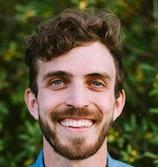
Speaker:
Ryan Trainor
Institution:
Caltech
Speaker Link:

Date:
Tuesday, May 27, 2014
Time:
4:00 pm
Location:
NS2 1201
ABSTRACT:
Accreting black holes liberate colossal amounts of energy, which allows us to trace the growth of black holes and galaxies from the first billion years after the Big Bang. However, the most luminous black holes (called QSOs, with luminosities up to 1014 Lsun) are extremely rare even at the peak redshifts of black hole growth, 2 < z < 3. I will present detailed probes of such hyperluminous QSOs and their environments at these redshifts using deep surveys of 1558 continuum-selected galaxies (LBGs; R < 25.5) and 890 Lyman-alpha-emitters (LAEs; R ~ 27) selected to lie in the neighborhoods of the QSOs. Using clustering statistics, we derive the mass of the dark-matter halos that host QSOs and LBGs and place their central black holes on the M_DM-M_BH relationship, finding a large discrepancy compared to the estimates at low redshift. We also present evidence that the QSOs are contributing to the Lya emission observed in the LAE sample on Mpc scales, and we constrain the lifetime and opening angle of QSO emission via the 3D distribution of these "fluorescent" Lya emitters. Finally, I will discuss prospects for further study of the QSOs and the Lya-emitting gas and galaxies via NIR and integral-field spectroscopy. Together, these projects provide a unique laboratory for studying the interdependent effects of galaxy evolution and black hole growth.
Host:
Michael Cooper