
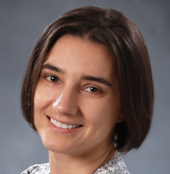
Speaker:
Reka Albert
Institution:
Penn State Univ.
Speaker Link:

Date:
Tuesday, February 5, 2013
Time:
11:00 am
Location:
NS2 3201
ABSTRACT:
Modeling the dynamics of complex biological systems is challenging even when well-established biochemical frameworks are applicable. In the case of regulatory and signaling systems that include heterogeneous components and interactions, and/or are sparsely documented in terms of quantitative information, modeling is often thought impossible. My group at Penn State is collaborating with wet-bench biologists to develop and validate predictive models of various biological systems, from signal transduction networks to the immune response to bacteria and to plant-animal communities. Over the years we found that discrete dynamic modeling is very useful in molding qualitative interaction information into a predictive model.
After a brief overview of other projects, this talk will focus on our modeling of survival signaling in cytotoxic T cells. These T cells should undergo programmed cell death after successfully fighting an infection, but in the disease T cell large granular lymphocyte (T-LGL) leukemia a fraction of them survive and eventually attack the joints or the bone marrow. We synthesized the relevant network of within-T-cell interactions from the literature, for a total of 60 nodes and 125 interactions.
We integrated this information with qualitative knowledge of the deregulated (abnormal) state of several network components and formulated a discrete dynamic model. The model indicated that the system possesses a steady state corresponding to the normal cell death state and a T-LGL steady state corresponding to the abnormal survival state. We evaluated each node's importance to the T-LGL state by maintaining the node in the state that is the opposite of its T-LGL state, e.g. knocking it out if it is overexpressed in the T-LGL state.
We found that such control of any of 15 nodes left cell death as the only outcome from any initial condition, thus these nodes are critical for the survival state. Our team validated two of these predicted key mediators experimentally. Overall, 68% of the predicted key mediators are corroborated by experimental evidence, and the rest are novel predictions that provide valuable guidance for future therapies.
Host:
Thorsten Ritz