
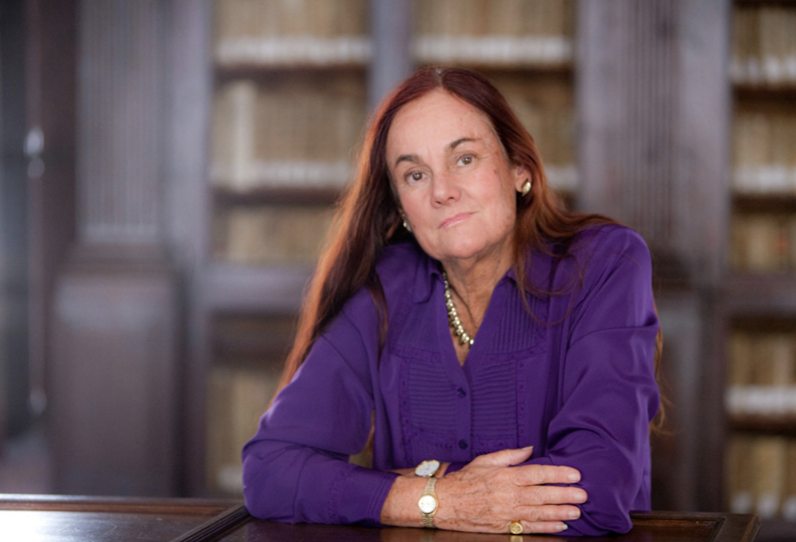
Professor Virginia Trimble Acknowledged by Sky & Telescope

Date: 
Tuesday, February 10, 2026

Sky & Telescope has published an article noting UCI's Virginia Trimble as a Famous and Noteworthy Astronomer.


Astronomer Virginia Trimble has called herself a magpie who likes shiny things. And for nearly 60 years, she found them across the universe: the Crab Nebula, white dwarfs, and binary stars.

A beloved teacher and colleague at the University of California, Irvine, Trimble was a charismatic presenter at conferences, a popular speaker at the world’s great universities and small colleges, and author of more than 1,000 papers. In 16 of those titles, she wrote droll, deeply researched annual reports on astrophysics around the world, covering research from nearby objects to the edge of time.

A 2018 Wired magazine profile called Trimble “the woman who knows everything about the universe.”

Nobelist in physics Kip Thorne of the California Institute of Technology told Sky & Telescope that Trimble’s photographic memory “captured and held enormous amounts of easily retrieved information about diverse astronomical phenomena and about the contributions, the insights, that had been made by an enormous numbers of colleagues.

“She was able to identify and explain unexpected connections between these diverse things, connections that the rest of us would miss,” he said. “This is what made her reviews so powerful. And her keen sense of humor made them delightful.”

“I can't think of anyone else who could have done that so well, because she did have a remarkable memory and could assimilate information very well,” Martin Rees, Great Britain’s astronomer royal from 1995 to 2025, told Sky & Telescope. “She rather enjoyed doing that.”

Virginia Trimble

Virginia Trimble
Astronomer Virginia Trimble has called herself a magpie who likes shiny things. And for nearly 60 years, she found them across the universe: the Crab Nebula, white dwarfs, and binary stars.

A beloved teacher and colleague at the University of California, Irvine, Trimble was a charismatic presenter at conferences, a popular speaker at the world’s great universities and small colleges, and author of more than 1,000 papers. In 16 of those titles, she wrote droll, deeply researched annual reports on astrophysics around the world, covering research from nearby objects to the edge of time.


A 2018 Wired magazine profile called Trimble “the woman who knows everything about the universe.”

Nobelist in physics Kip Thorne of the California Institute of Technology told Sky & Telescope that Trimble’s photographic memory “captured and held enormous amounts of easily retrieved information about diverse astronomical phenomena and about the contributions, the insights, that had been made by an enormous numbers of colleagues.

“She was able to identify and explain unexpected connections between these diverse things, connections that the rest of us would miss,” he said. “This is what made her reviews so powerful. And her keen sense of humor made them delightful.”

“I can't think of anyone else who could have done that so well, because she did have a remarkable memory and could assimilate information very well,” Martin Rees, Great Britain’s astronomer royal from 1995 to 2025, told Sky & Telescope. “She rather enjoyed doing that.”

ACADEMIC FIRSTS

Born November 15, 1943, in Los Angeles, Virginia Louise Trimble was the adored only child of a chemist and a homemaker keen on language. After graduation from Hollywood High School in 1961, she was the first woman student in the astronomy and physics program at the University of California, Los Angeles (UCLA). No less a cultural force than LIFE magazine took note in October 1962, with a feature and three photographs of the striking Trimble and the headline: “Behind a Lovely Face, a 180 IQ.”

The story landed Trimble a yearlong ad-agency gig as “Miss Twilight Zone,” promoting Rod Serling’s sci-fi television series. The pay covered Trimble’s tuition and books for several semesters. In a publicity photograph, Serling and Trimble smile as they look at a script he holds.

Virginia Trimble, Rod Serling

Hanging by a piece of tape on a wall in Virginia Trimble's office is an old publicity photograph of television producer Rod Serling with Trimble when she worked as "Miss Twilight Zone" as a college student.
Photograph of Trimble's office by Aaron Barth

A Woodrow Wilson fellowship got her to graduate school at Caltech, one of 14 women students on campus. (Caltech did not admit undergraduate women then, and made only a few exceptions for graduate school.)

In 1966, Trimble took a class on relativity, the first offered by a new physics professor, Kip Thorne. “I always arrived about 15 minutes early to put stuff on the blackboard, and she always arrived before I did,” he said. “She was just avidly learning this stuff. We had conversations, and I was quite impressed by her.”

Trimble, the second woman given access to the Palomar Observatory, used its 48-inch telescope to study the Crab Nebula in narrow wavelength bands. She focused on the distribution of the Crab pulsar’s ionizing radiation within the nebula as well as the energy from the collision of the nebula’s edges with interstellar material.

Posing for Feynman

One day, Caltech physicist and Nobel laureate Richard Feynman, a beginning artist, spotted Trimble on campus. He approached her adviser for an introduction, “I’m hunting, perhaps you know the quarry.” He offered $5.50 an hour, so on Tuesdays, Trimble went to Feynman’s basement studio where she posed, he drew, and they talked physics. Trimble always said nothing else happened. Mrs. Feynman was upstairs.

Rees met Trimble in 1968 when he came from Cambridge University to Caltech for a postdoctoral fellowship. The friendship grew when Trimble later did her postdoc at Cambridge. Rees remembered her as “very lively and elegant.” After a brief stretch at Smith College, Trimble returned to Southern California as the first woman on the UC Irvine astrophysics faculty.

At a 1970 conference, she met Joe Weber of the University of Maryland, then one of the nation’s most famous scientists. The year before, he had announced that a device he built had detected gravitational waves, spacetime ripples that cause effects smaller than an atomic nucleus.

At the conference, Trimble tossed a question to Weber, and he “royally” snubbed her. He intrigued her, but he was married. Also, she was 28, and he was 51.

“He idolized her”

Two years later, Weber, by then widowed, wrote to Trimble that he would be visiting, and he wanted to buy her dinner. Trimble picked him up at the airport. They spent the next three weekends together, then they got married.

Virginia Trimble in 1988

Virginia Trimble in 1988, at a meeting of the International Astronomical Union
AIP Emilio Segre Archives, John Irwin Slide Collection

By then, though, the physics community was challenging Weber’s discovery. Other scientists could not replicate his results and suggested he had misinterpreted noise. In 1987, the National Science Foundation did not renew Weber’s funding, opting to support the Laser Interferometer Gravitational-Wave Observatory. On the LIGO team was Thorne, who had been inspired to search for gravitational waves by long conversations with Weber in 1963.

But the professional hardship did not affect the marriage, and Thorne could see why.

“He idolized her. He understood how brilliant she was,” he said. “To him, she was the most important person in the world, and he did everything he could to support her, and she did everything she could to support him.”

Trimble’s influential research on white dwarfs and binary stars appeared in leading journals including The Astrophysical Journal, Astronomy and Astrophysics, Monthly Notices of the Royal Astronomical Society. But just as interesting, Thorne and Rees said, were her reviews of research around the world in Reviews of Modern Physics, Annual Reviews of Astronomy and Astrophysics, Nature, Science, Physics Today, The Observatory, New Astronomy Reviews, Journal for the History of Astronomy, Scientometrics, and others.

In 1986, the National Academy of Sciences awarded Trimble the J. Murray Luck Prize for Scientific Reviewing for shedding light on “many complex astrophysical questions.”

A Challenging Assignment

In 1990, the editor of the Publications of the Astronomical Society of the Pacific tossed out an unusual assignment: a yearly review of astrophysics, broadly defined. The magpie accepted the challenge. She read the ink-on-paper issues of 26 leading journals to find the shiniest bits, organizing them from near to far. From the first article, “Astrophysics in 1991,” the reviews were must-reads, nearly every paragraph dishing both data and jokes.

Astronomer Aaron Barth, now Trimble’s colleague at UC Irvine, said that in graduate school, he found her essays a sensation for their ambition and scope. Every year, astronomers checked Trimble’s source lists first to see who made the cut. “Then,” he said, “once you were producing your own research, if you made it into one of those, you felt like your work had been noticed by someone important.”

Weber died in 2000. He and Trimble had been married 28 years, and in “Astrophysics in 2001,” she paid gentle tribute. Weber, she wrote, had two favorite expressions: “ ‘Oh, isn’t that too bad?’ (which covered the territory from broken glassware to the deaths of colleagues), and ‘Oh, isn’t that nice?’ (which extended from fresh raspberries to Nobel Prizes).”

In “Astrophysics in 2004,” Trimble warned, “The set of papers about small objects was considerably larger than the set of papers about large objects, and the following is either wisely selective or incredibly prejudiced, depending on whether your paper is mentioned.”

As the field of astronomy grew, so did Trimble’s reviews. “Astrophysics in 1991” was 14 pages, but “Astrophysics in 2006,” was 364. The rising tide of research had swamped even Trimble, and the annual essay was retired. But her writing had become a foundation for a new field, scientometrics: the qualitative study of the progress of science.

Virginia Trimble

Top (L-R): AIP Emilio Segrè Visual Archives, John Irwin Slide Collection; AIP Emilio Segrè Visual Archives, John Irwin Slide Collection; AIP Emilio Segrè Visual Archives Bottom (L-R): Photograph by Malcolm Tarlton, AIP Photographer, courtesy AIP Emilio Segrè Visual Archives; Mark Maier

The Credit Due to Weber

At a February 2016 news conference in Washington, D.C., the LIGO team announced that it had detected gravitational waves from the collision of two black holes. Thorne and others praised Weber for initiating the quest and said their breakthrough might not have happened without Weber showing that Einstein’s relativistic theory of the waves could move into the lab. They also acknowledged Weber’s widow, who was in the front row.

Afterward, a reporter for Science asked Trimble whether she believed Weber had detected gravitational waves in 1969. “I don’t know,” she replied, but if the National Science Foundation had funded Weber as well as LIGO, the teams “would have pushed each other as collaborators not as competitors, and it might have led to an observation sooner.”

In 2017, Thorne, Rainer Weiss, and Barry Barish earned the Nobel Prize in physics for the LIGO discovery.

“Overdue for recognition”

Trimble never retired, arriving at her office at UC Irvine every day before anyone else. In 2018, for her 75th birthday and the 50th anniversary of her doctorate, UC Irvine threw TrimbleFest, a symposium on her impact and gala dinner that drew dozens of friends, students, and colleagues. Rees flew in from England. On an easel stood Feynman’s delicate charcoal portrait of the young Trimble, dark hair pouring over a shoulder.

For Trimble’s 2022 nomination to the American Academy of Arts and Sciences, Rees and Thorne collaborated on a letter urging no further delay:

“This astonishing lifetime’s achievement has been underappreciated. She is overdue for recognition from the community of which she has been such a distinctive and energetic member and which she has served with such exceptional dedication for more than 45 years.”

Neither cancer treatment nor the COVID-19 pandemic kept Trimble from beating the sunrise to her office. But a severe stroke in 2024 disabled her, and recovery at a care facility has been long and slow. On Trimble’s behalf, UC Irvine officials declined Sky & Telescope’s request for an interview with her.

A cousin of Trimble, who visits her regularly, has arranged FaceTime calls for Rees. Thorne and his wife visited Trimble in early January 2026 and were delighted to find her listening to a lecture by cosmologist Alan Guth.

At UC Irvine, Barth said he used to stop nearly every morning by Trimble’s office, and they would catch up on events in astronomy. But since the stroke, her door has been closed, the office untouched, the towers of books and papers telling of all the shiny things. On a wall, a piece of tape holds the old publicity photograph, of Rod Serling and Miss Twilight Zone, on her way to knowing everything about the universe.

Awards and honors

Among Trimble’s popular books are 1992’s Visit To a Small Universe and 2022’s The Sky Is for Everyone: Women Astronomers in Their Own Words, with David A. Weintraub. Among her awards:

  • The 2001 Klopsteg Memorial Award from the American Association of Physics Teachers “for her leadership, her contributions to the literature, and her dedication as a teacher.”
  • The 2010 George Van Biesbroeck Prize for “expert assessments of progress in all fields of astrophysics and her significant roles in supporting organizations, boards, committees, and foundations in the cause of astronomy.”
  • The 2019 Andrew Gemant Award by the American Institute of Physics.
  • The 2024 Abraham Pais Prize for History of Physics by the American Physical Society.
  • Election in 2020 as a Legacy Fellow of the American Astronomical Society.
  • The discoverers of main-belt asteroid 9271 Trimble named the rock in her honor.


Publication: 

Sky & Telescope