
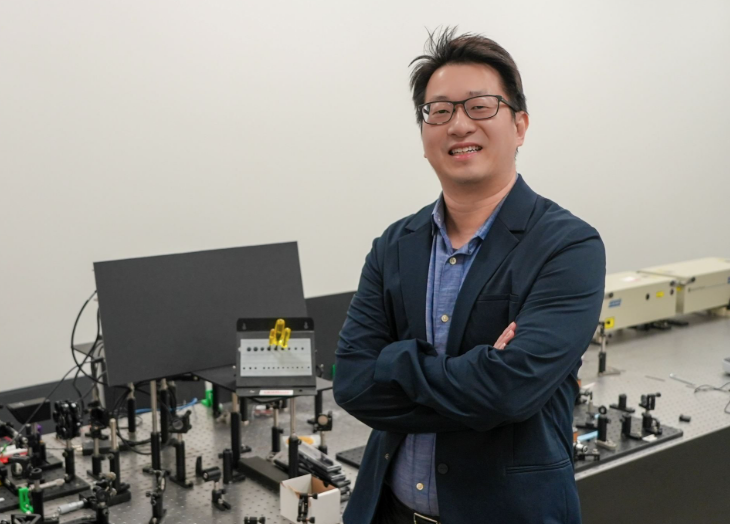
Professor Howard Lee has been selected as a Humboldt Research Fellow, enabling him to collaborate with Nobel laureate Ferenc Krausz at the Max Planck Institute of Quantum Optics. The fellowship will expand Lee’s pioneering work in controlling light and accelerate discoveries in ultrafast photonics.
Picture Credit: UC Irvine
The fellowship will expand Lee’s pioneering work in controlling light and accelerate discoveries in ultrafast photonics in collaboration with Nobel laureate Ferenc Krausz
Professor Howard Lee of the UC Irvine Department of Physics & Astronomy has been awarded a Humboldt Research Fellowship from the Alexander von Humboldt Foundation. The fellowship will allow Lee to spend up to 18 months in Germany collaborating with Dr. Ferenc Krausz, winner of the 2023 Nobel Prize in Physics, at the Max Planck Institute of Quantum Optics in Munich. The partnership will significantly advance Lee’s research into ultrafast photonics by giving his group access to some of the world’s most sophisticated attosecond-level laser systems.
Lee’s research focuses on manipulating light at the nanoscale, an essential capability underlying modern technologies, from fiber-optic networks to biomedical optical devices. By exploring how light interacts with materials on attosecond timescales (one quintillionth of a second), his work aims to enable the ultrafast modulation needed for next-generation communication platforms, future optical computing, and the precision probing of complex biomolecules.
“Although my work isn’t directly in attosecond physics, we’re interested in expanding our capabilities and understanding, and applying ultrafast pulse techniques to the nanomaterials and nanostructures we study,” Lee said.
Professor Lee with Ph.D. student Quynh Dang. Dang will be conducting research with Lee as part of his Humboldt fellowship.

Only a handful of facilities worldwide can perform attosecond-level measurements due to the extreme precision required. Lee explained that combining his group’s expertise in meta-materials and nano-optics with the advanced ultrafast laser infrastructure in Germany creates a unique opportunity to probe optical and electronic behaviors that have never been observed.
“Prof. Ferenc Krausz is a pioneer in the field of attosecond photonics, which makes this collaboration so compelling.” said Lee. “By combining our unique materials and nanostructures with their world-leading expertise and advanced ultrafast laser systems, we are positioned to explore entirely new frontiers in physics.”
The Humboldt Research Fellowship program is part of the Global Minds Initiative Germany of the Federal Ministry of Research, Technology and Space, a cabinet-level ministry of the German government.
UCI Physical Sciences